Ever wonder why trading feels like an emotional rollercoaster?
You're not alone. Most traders, from rookies to seasoned pros, wrestle with the same demon: their own emotions.
Think about it: you've got a plan, you've done your analysis, everything looks perfect.
Then, the market does something unexpected. A small move against you, and suddenly, fear takes over.
Or worse, you spot an opportunity that looks too good to be true, and FOMO (fear of missing out) shoves you into a trade without thinking.
Sound familiar? That's because trading isn't just about numbers and charts.
It's a constant battle against your own psychology. And if you don't master it, it'll master you, emptying your account in the process.
Here, I'm going to break down how you can take control, not just of your trades, but of your mind.
Let's talk about how to control trading emotions so you can start seeing real results.
The Hard Truth: Your Emotions Are Your Worst Enemy
Let's be real. Nobody gets into trading expecting to lose money.
We all want to win, and fast. That's the first trap.
The expectation of quick, easy gains is a magnet for impulsive decisions.
When real money is on the line, your primal brain—the one that tells you to flee danger or chase reward—takes over.
This leads to classic mistakes I've seen time and time again.
The Four Horsemen of Emotional Trading Apocalypse
Certain emotions are pure poison for your trading account.
If you don't identify and manage them, they will destroy you. Here are the main culprits:
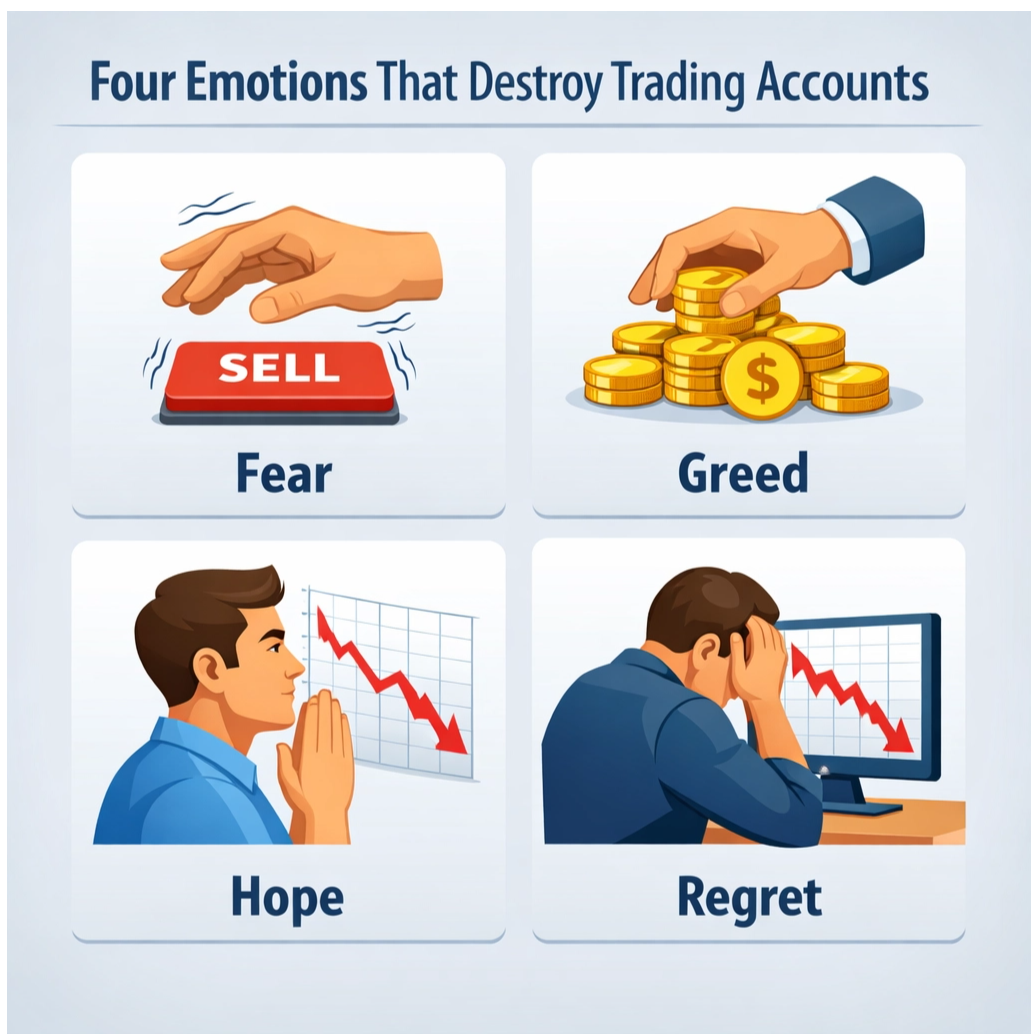
•Fear: Fear paralyzes you. It stops you from entering good trades or makes you exit winning trades too early.
I remember one time I had a position going well, but the market started consolidating a bit.
The fear of it reversing made me close the trade for a minimal profit, only to watch it continue climbing and hit my original target.
That feeling of leaving money on the table is brutal.
•Greed: Greed blinds you. It makes you hold onto losing trades hoping they'll recover, or pushes you to take excessive risks. It's that voice in your head saying, "Just a little more, just a little more."
And before you know it, what was a decent gain turns into a loss.
•Hope: Hope, in trading, is dangerous. It makes you ignore exit signals and cling to a losing trade. "Maybe it'll bounce," "surely it'll turn around."
Hope isn't a strategy. It's a way to avoid reality.
•Regret: Regret haunts you. You kick yourself for trades you didn't take or for those you closed too soon.
This leads to revenge trading, trying to make back losses with impulsive moves.
It's a vicious cycle that drags you down.
Here's an image that sums it up pretty well:
 |
| Source: Medium.com, "The 5 Emotional Patterns That Quietly Ruin Most Traders (And How To Spot Yours)" |
The Battle Plan: How to Defuse the Emotional Bomb
Okay, you know the enemies. Now, how do you fight them?
It's not about eliminating emotions entirely; that's impossible. It's about recognizing and managing them.
Here are some proven strategies I use myself and have seen work for others.
1. Have a Trading Plan (And Stick to It Like Glue)
Sounds obvious, right? But most people don't do it, or they do it halfway.
Your trading plan is your map, your constitution, your bible.
It should include:
•Your entry rules: When do you enter a trade? What technical or fundamental criteria must be met?
•Your exit rules: When do you get out? This is crucial. Define your take profit and stop loss before you even enter.
•Risk management: How much are you willing to lose per trade? What percentage of your total capital?
Don't risk more than 1-2% of your capital per trade. This is non-negotiable.
•Assets to trade: What markets will you focus on? Don't try to trade everything.
Once you have your plan, the key is unwavering discipline.
If your plan says "exit at X," you exit at X. No ifs, no buts, no "maybes."
It's like a pilot. They have a flight plan. If they deviate due to emotion, disaster is imminent.
2. The Trading Journal: Your Personal Therapist
This is pure gold, and almost nobody does it right.
After every trade, write everything down. Not just whether you won or lost, but:
•Why you entered: What made you think it was a good trade?
•Why you exited: Did you follow your plan? Or did fear or greed take over?
•Your emotional state: How did you feel before, during, and after the trade?
Were you stressed? Anxious? Excited?
•Lessons learned: What would you do differently next time?
Review your journal regularly. Look for patterns.
You'll see how your emotions influence your decisions and where you need to improve.
It's like having a conversation with yourself, but on paper.
3. Manage Risk Like a Pro (Because You Are One)
Risk management is the pillar of longevity in trading.
If you don't manage your risk, you're not trading; you're gambling.
•Position sizing: Calculate your position size based on your stop loss and the percentage of risk you're willing to take.
Never, under any circumstances, trade with a position size that makes you uncomfortable.
•Stop Loss: Always use a stop loss. Always.
It's your insurance. It's what protects you from a catastrophic loss.
Once you set it, don't move it against yourself. That's financial suicide.
•Diversification: Don't put all your eggs in one basket.
Trade different assets or strategies to reduce overall risk.
Understanding that losses are part of the game is fundamental.
You can't win every trade. Nobody can. The goal is for your wins to outweigh your losses.
4. Disconnect and Recharge
Trading can be mentally exhausting.
Being glued to the screen all day, watching every tick, is a recipe for emotional burnout.
•Take breaks: Step away from the screen. Go for a walk, exercise, read a book.
Clearing your mind helps you come back with a fresh perspective.
•Set hours: Define when you're going to trade and when you're not.
Don't trade outside your designated hours. The market will always be there.
•Don't trade if you're emotionally compromised: If you had a bad day, an argument, or just don't feel right, don't trade.
Your mental state is your most valuable asset.
A trader friend once told me, "If you're not 100%, your account won't be either." And he was absolutely right.
5. Continuous Education and Humility
Markets are constantly changing. What worked yesterday might not work today.
•Learn non-stop: Read books, watch webinars, follow successful traders (but with a critical eye).
Never stop learning and adapting.
•Stay humble: The market always has the last word.
No matter how much you know, there's always something new to learn, and you can always be wrong.
Arrogance is one of the most dangerous emotions in trading.
It makes you think you're invincible, and that's when the market slaps you with a reality check.
Stories from the Trenches: When Emotions Attack
Let me tell you a couple of quick stories so you can see how this plays out in real life.
I knew a trader who was brilliant at analyzing charts.
He could predict movements with astonishing accuracy. But he had one problem: FOMO.
Every time he saw an asset skyrocket, he'd jump in without a plan, without a stop loss, just out of fear of missing the "big opportunity."
At first, he had a few lucky trades that reinforced his bad habit.
But eventually, a series of impulsive entries at the top of moves cost him a significant portion of his capital.
He had to stop, re-evaluate, and rebuild his approach from scratch, focusing on discipline.
Another case was a trader who, after a series of losses, went into "revenge trading" mode.
He was furious with the market and himself. He decided to double his position size to "make back" his losses quickly.
Of course, the market owed him nothing. Those revenge trades only dug him deeper into the hole.
He had to learn the hard way that the market isn't personal.
You can't fight it with emotions. You can only follow your rules and manage your risk.
Conclusion: Self-Mastery Is the Real Success
At the end of the day, trading is a game of probabilities and risk management.
But the most unstable and powerful variable is yourself.
Controlling trading emotions isn't a skill you acquire overnight.
It's a continuous process of self-awareness, discipline, and constant improvement.
If you can master your fears, your greed, your hope, and your regret, you'll be one step closer to consistency.
Don't look for the holy grail in a secret strategy or a magic indicator.
The real holy grail is in your mind. Master it, and you'll master the market.
That's how you can truly control trading emotions and, over time, start making consistent money.


No comments:
Post a Comment