Friday, July 10, 2026

2 ETFs To Invest In With High Reward Potential

You're tired of watching your money sit in a savings account earning basically nothing.

You want growth, but you don't want to gamble your rent money on some random stock tip from Reddit.

I get it.

That's the exact tension I want to solve in this article.

We're going to talk about two ETFs with high reward potential, why they're built the way they are, and how to actually buy them today — not just theory, actual steps.

Let's get into it.

Why "High Reward Potential" Also Means Higher Risk

Quick reality check before we go further.

Anything labeled "high reward" comes with volatility attached.

That's not a warning to scare you off.

It's just math.

The ETFs that can double your money in a good year can also drop 30-40% in a bad one.

So here's the rule I live by: high-reward ETFs are a slice of your portfolio, not the whole pie.

Think of it like hot sauce.

A little bit makes the meal exciting.

Too much and you can't taste anything else.

ETF #1: ARK Innovation ETF (ARKK)

If you want pure, unfiltered exposure to "disruptive innovation," this is the fund everyone talks about.

ARKK is actively managed, which means real humans (led by Cathie Wood and her team) are picking the companies, not just tracking an index.

What's actually inside it:

  • Genomics and biotech companies betting on the future of medicine
  • Robotics and automation plays
  • Fintech and blockchain-adjacent businesses
  • Companies tied to autonomous technology and AI

Here's the thing about ARKK.

It's not for the faint of heart.

As an actively managed ETF, it carries a relatively high expense ratio of 0.75%.

That's steep compared to your average index fund.

But you're paying for a team that's making concentrated, high-conviction bets on companies most investors have never heard of.

Who this is actually for:

  • You already have a solid core portfolio and want a "growth satellite"
  • You believe certain emerging tech sectors are underpriced right now
  • You can stomach a 30%+ drawdown without panic-selling

Who this is NOT for:

  • Anyone who needs this money in the next 1-3 years
  • Anyone who checks their portfolio every day and stresses over red numbers

ETF #2: iShares Future AI & Tech ETF (ARTY)

You can't have a "high reward" conversation in 2026 without talking AI.

That's just where the money and momentum are right now.

ARTY offers targeted exposure across the AI value chain, including generative AI, AI data and infrastructure, semiconductors, software, and AI-enabled services.

What I like about this one specifically:

it uses a global lens that extends beyond the usual U.S. mega-cap tech names to include major AI-spend recipients like Taiwan Semiconductor and SK Hynix.

Translation: you're not just betting on Nvidia and Microsoft.

You're getting the whole supply chain — the chipmakers, the infrastructure, the software layer.

And the returns have reflected that appetite.

As of mid-June 2026, ARTY had returned 96% over the trailing 12 months.

That's not a typo.

But before you get too excited, remember what we talked about earlier.

This comes with higher volatility and higher expenses, so it's meant to be a satellite fund, not your core holding.

Bottom line: if you believe AI keeps reshaping the global economy over the next decade, ARTY gives you a way to ride that wave without picking individual chip stocks yourself.

Quick Comparison Table

ETFFocusExpense Ratio1-Year Return*Best For
ARKK (ARK Innovation)Disruptive tech, biotech, robotics0.75%Volatile, cyclicalHigh-conviction believers in emerging tech
ARTY (iShares Future AI & Tech)Global AI value chain, semiconductorsHigher-than-average~96% (trailing 12mo, mid-June 2026)Investors wanting broad AI exposure

*Returns are historical and not a guarantee of future performance. Markets move. Do your own math before you buy.

How To Actually Buy These ETFs (Step By Step)

This is the part most articles skip.

They tell you what to buy and never tell you how.

Here's the actual process:

  1. Open a brokerage account if you don't already have one. You want something with zero-commission trades and no minimum deposit requirements.
  2. Fund the account with an amount you're actually okay watching swing up and down.
  3. Search the ticker (ARKK or ARTY) in the app's search bar.
  4. Decide market order vs. limit order. A market order buys at whatever the current price is. A limit order lets you set the exact price you're willing to pay.
  5. Start small. You don't need to go all-in on day one. Dollar-cost averaging (buying a fixed amount on a regular schedule) smooths out the wild price swings these funds are known for.

What If High Reward ETFs Feel Too Risky Right Now?

Real talk.

Not everyone is in a place to swing for the fences.

Maybe you just want your money to grow steadily and throw off some cash along the way.

If that's you, dividend stocks might fit better into your plan than pure growth ETFs.

You don't have to pick one lane forever.

A lot of smart investors run both — a high-reward growth sleeve and a steady dividend sleeve — so one balances the other.

The Mistake Most People Make With High Reward ETFs

I see this constantly.

Someone reads an article like this one, gets excited, and dumps their entire emergency fund into ARKK because it's "going to the moon."

Then the fund drops 25% in six weeks (which, by the way, is completely normal for these types of funds) and they panic-sell at the bottom.

That's not investing.

That's gambling with extra steps.

The fix is simple:

  • Only invest money you won't need for at least 5+ years
  • Know going in that you WILL see red numbers sometimes
  • Set a percentage of your total portfolio you're willing to allocate to high-risk, high-reward plays (many people use 5-15%) and stick to it

That's it.

That's the whole game.

Final Thoughts

Both ARKK and ARTY give you real exposure to the kind of innovation that could define the next decade — biotech breakthroughs, robotics, and the AI infrastructure boom.

They're not "set it and forget it" safe funds.

They're the high-octane part of a well-built portfolio.

Treat them that way, size your position accordingly, and you give yourself a real shot at meaningful upside without betting the farm.


This article is for informational purposes only and is not financial advice. Talk to a licensed financial advisor before making investment decisions.

Tuesday, July 7, 2026

Three Black Crows Pattern: Your Guide to Spotting Bearish Reversals

Ever felt that gut-wrenching feeling when the market suddenly turns against you, wiping out your gains faster than you can say "bear market"?

We've all been there, wondering if there was a sign we missed. What if I told you there's a powerful candlestick pattern that can often signal such a shift, giving you a heads-up to protect your investments or even profit from the downturn? That's where the Three Black Crows Pattern comes in.

What Exactly is the Three Black Crows Pattern?

Imagine a strong uptrend, where prices are steadily climbing, and everyone feels good. Then, out of nowhere, three consecutive bearish candles appear, one after another, pushing prices lower. This is the essence of the Three Black Crows. It's a visual indicator, a story told by the candlesticks themselves, suggesting that the bulls (buyers) are losing control and the bears (sellers) are taking over.
It is a bearish reversal pattern, just like the Evening Star formation.

It's like watching three dark figures emerge from the shadows, signaling a change in direction. This pattern is generally considered a bearish reversal pattern, meaning it often appears after an extended period of rising prices and hints that a downtrend might be on its way .

Key Characteristics of the Three Black Crows:

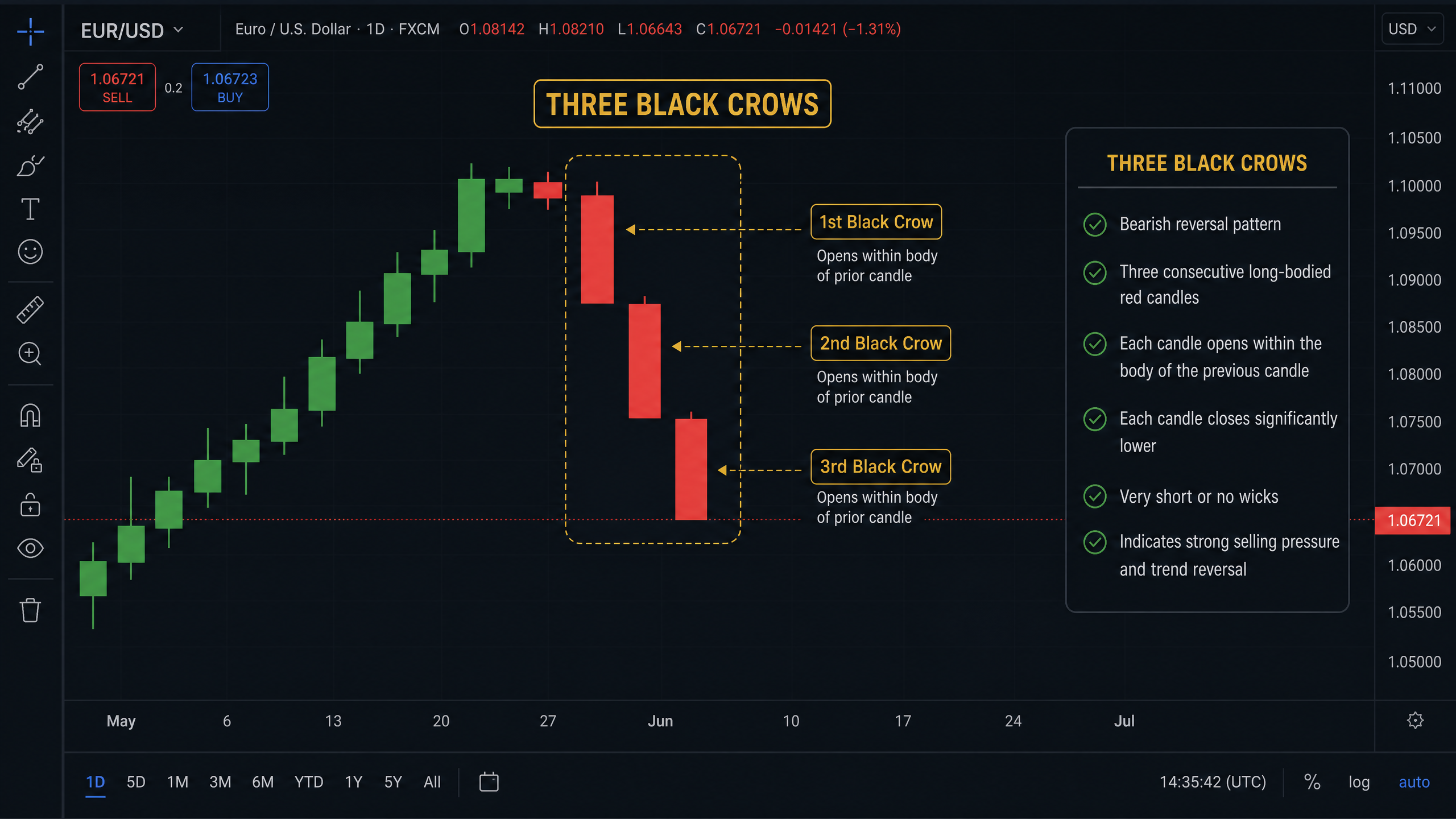
Three Consecutive Bearish Candles: These are typically long-bodied red (or black) candles, indicating significant selling pressure.
Opening Within the Previous Body: Each of the three bearish candles should open within the real body of the candle preceding it.
Closing Lower: Each candle closes lower than the previous one, ideally near its low, showing sustained downward momentum.
Small or Non-existent Wicks: This suggests that sellers were in firm control throughout the trading session, with little buying interest pushing prices back up .

Here's a visual to help you spot it:
Three Black Crows Pattern Structure

How I Spot and Analyze the Three Black Crows

When I'm looking at a chart, I'm not just seeing lines and colors; I'm trying to understand the market's narrative. The Three Black Crows pattern is a strong chapter in that story. It's most reliable when it forms after a clear, established uptrend. If it pops up in choppy, sideways action, its signal might be less potent.
Context is King: Always consider the bigger picture. Is the market overbought? Are there other technical indicators, like the Relative Strength Index (RSI) showing divergence or entering overbought territory, that support a potential reversal? These confirmations can significantly increase the pattern's reliability .
Volume Matters: Pay attention to trading volume during the formation of the crows. Ideally, you'd see an increase in volume during these three bearish days. This suggests that a significant number of sellers are entering the market, adding conviction to the bearish signal. If volume is low, it might just be a temporary dip, not a full-blown reversal.

IF YOU WANT TO TAKE YOUR STOCK INVESTMENT TO THE NEXT LEVEL, READ MY CAPITALIST EXPLOITS REVIEW HERE

Trading the Three Black Crows Pattern: My Approach

So, you've spotted the Three Black Crows. Now what? This pattern can be a bit tricky because the price drop can be quite steep, making risk management crucial. Here’s how I think about trading it:

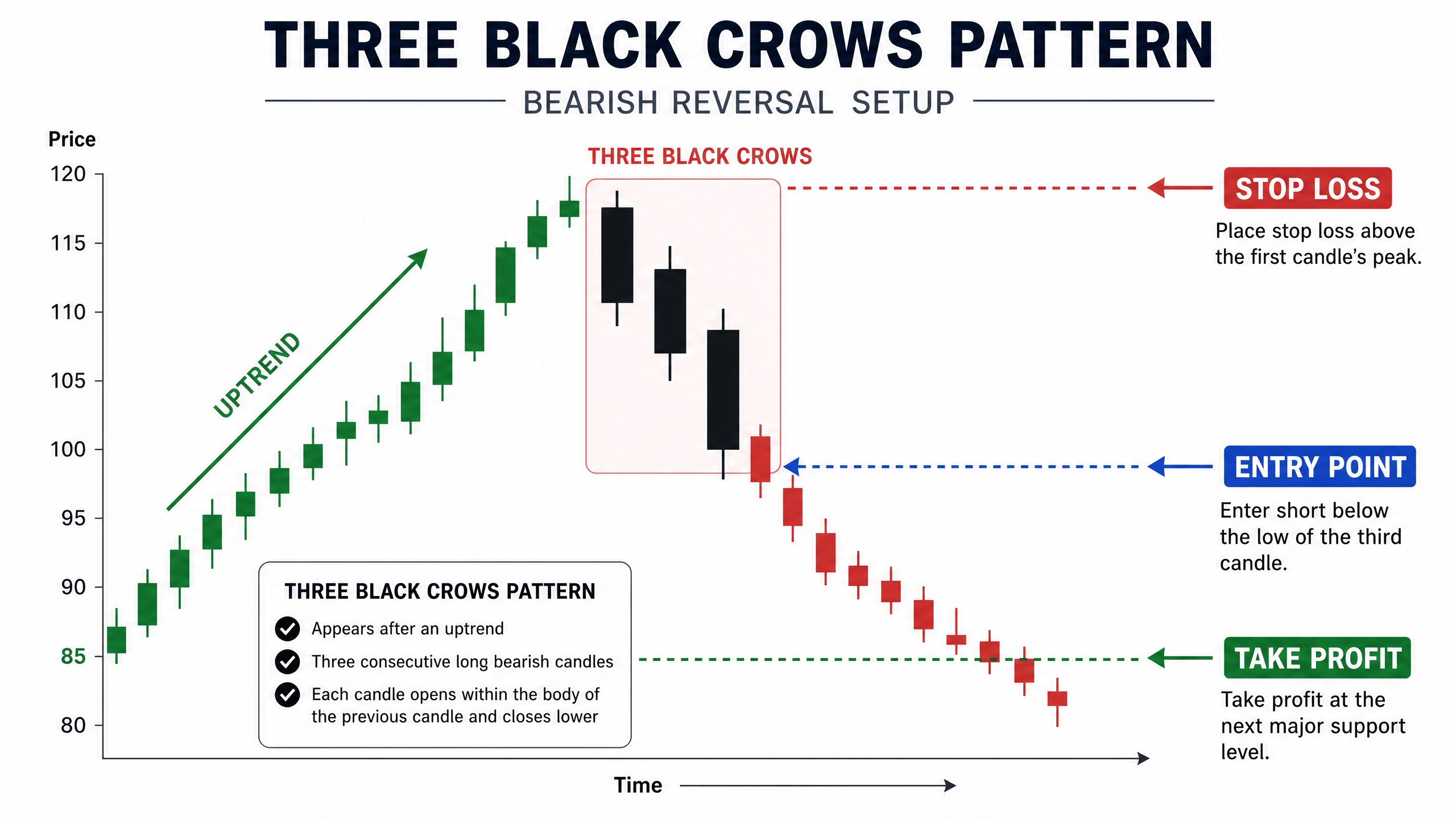
Entry Point: I typically look to enter a short position after the third black crow has closed, confirming the pattern. Some aggressive traders might enter during the third candle, but waiting for the close offers more confirmation.

Confirmation is Key: Before jumping in, I always look for additional bearish confirmation. This could be a break below a key support level, a bearish cross of moving averages, or other indicators aligning with the downtrend.

Stop Loss Placement: This is vital. I usually place my stop loss above the high of the first or second black crow, or even above the high of the candle preceding the pattern. This limits potential losses if the market decides to resume its uptrend.

Take Profit Targets: I often use previous support levels as potential take-profit targets. Another strategy is to measure the length of the uptrend preceding the pattern and project a similar move downwards. Remember, it's about finding a good risk-to-reward ratio.

Here’s an example of a potential trading setup:
Trading Setup Guide

Three Black Crows vs. Three White Soldiers

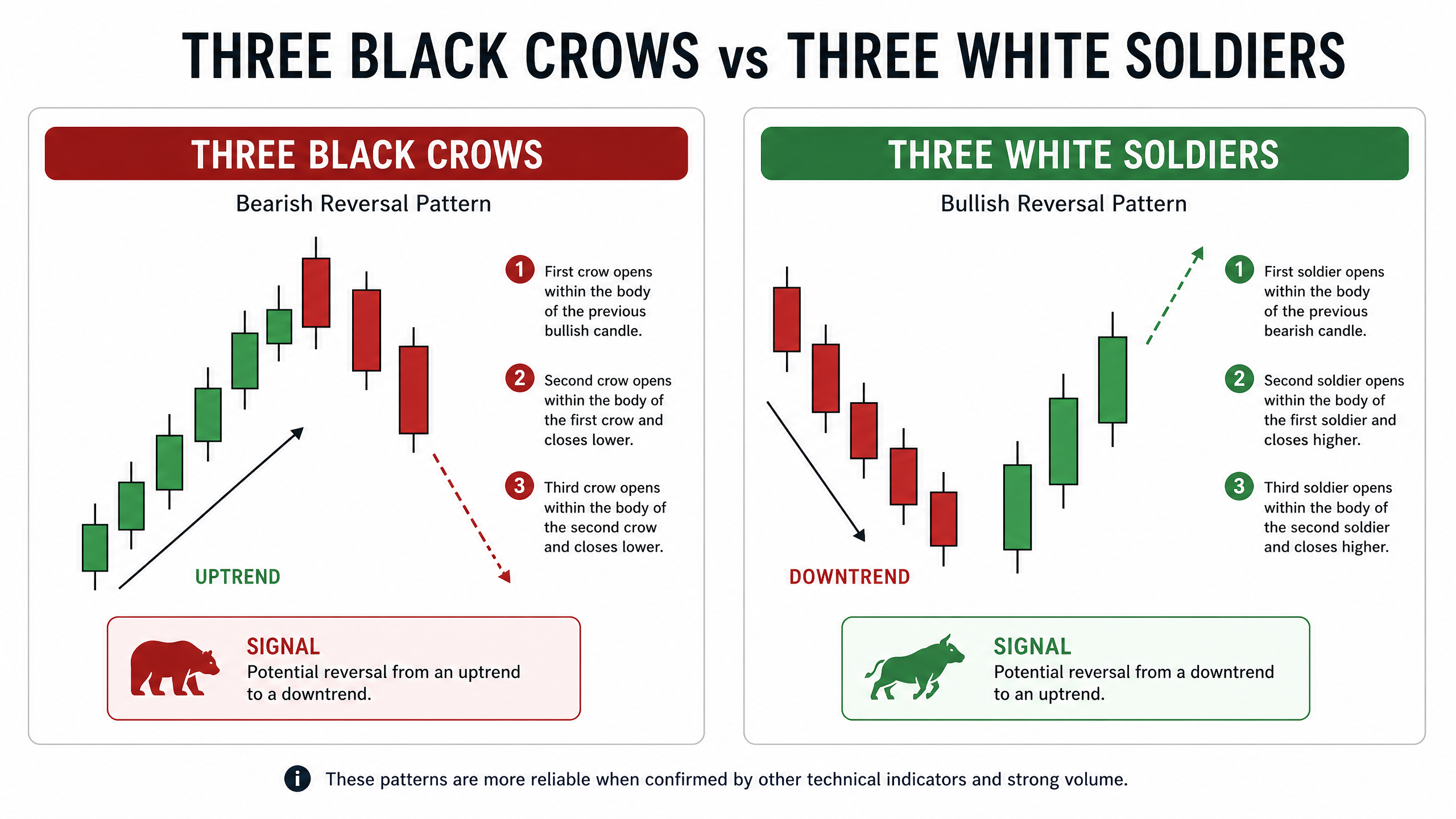
It's helpful to understand the Three Black Crows by looking at its opposite: the Three White Soldiers Pattern. While the Crows signal a bearish reversal after an uptrend, the Soldiers signal a bullish reversal after a downtrend.

It's essentially the mirror image, with three consecutive long-bodied bullish (green or white) candles, each opening within the previous body and closing higher .
Understanding both helps you recognize market shifts in either direction.
Always make sure to scan the best stocks to trade.

Three Black Crows vs Three White Soldiers

When the Three Black Crows Pattern Might Fail

No pattern is foolproof, and the Three Black Crows is no exception. It's not a magic bullet, and sometimes, it can fail. Here are a few scenarios:

Lack of Overbought Conditions: If the preceding uptrend wasn't particularly strong or extended, the pattern might just be a temporary pullback before the uptrend resumes.

Low Volume: As mentioned, low volume during the bearish candles can indicate a lack of conviction from sellers, making the reversal less likely to stick.

Immediate Bounce Back: Sometimes, after the three crows, the price might quickly bounce back, negating the bearish signal. This is why a stop loss is so important.

Always remember, this pattern is a tool in your trading arsenal, not the entire strategy. Combine it with other forms of technical analysis and risk management.

Frequently Asked Questions about the Three Black Crows Pattern

Q: What does the Three Black Crows pattern mean?

A: It signals a potential bearish reversal in the market. It suggests that sellers have taken control from buyers after an uptrend, indicating that prices may continue to fall.

Q: How reliable is the Three Black Crows pattern?

A: Its reliability increases when it appears after a clear uptrend, with each candle closing near its low, and ideally with increasing volume. Always use it in conjunction with other indicators for confirmation.

Q: What is the opposite of the Three Black Crows?

A: The opposite is the Three White Soldiers pattern, which is a bullish reversal pattern appearing after a downtrend.

Q: Can I use the Three Black Crows pattern in all markets?

A: Yes, it can be applied to various financial markets, including stocks, forex, and cryptocurrencies. However, its effectiveness can vary depending on market conditions and liquidity.

Q: Should I trade solely based on the Three Black Crows pattern?

A: Absolutely not. While powerful, it should always be used as part of a broader trading strategy, combined with other technical analysis tools, fundamental analysis, and strict risk management.

Final Thoughts on the Three Black Crows Pattern

The Three Black Crows Pattern is a compelling visual signal that can help you anticipate potential market reversals. By understanding its characteristics, knowing how to confirm its signals, and applying sound risk management, you can use this pattern to make more informed trading decisions.

Remember, trading involves risk, and past performance is not indicative of future results. This content is for informational purposes only and should not be considered financial advice. Always do your own research and consult with a financial professional before making any investment decisions.
You can check this trading patterns cheatsheet for more setups.

References

2 ETFs To Invest In With High Reward Potential

You're tired of watching your money sit in a savings account earning basically nothing. You want growth, but you don't want to gam...